
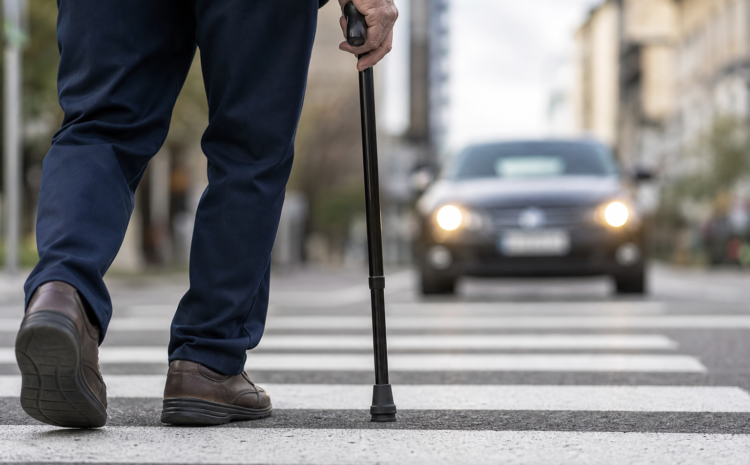
Pedestrians are among the most vulnerable people on the road. When a vehicle strikes a person on foot, the results are almost always serious — and often life-altering. Unlike vehicle occupants, pedestrians have no metal frame, no airbags, and no seatbelt standing between them and the force of impact.
If you or a family member has been struck by a vehicle while walking in Colorado or Nevada, understanding your legal rights is essential. Here’s what the law says, what you can recover, and what steps to take.
1. Who Has the Right of Way? Understanding Pedestrian Traffic Laws
A common misconception is that pedestrians always have the right of way. The reality is more nuanced — and understanding the rules helps establish fault after an accident.
In Colorado (C.R.S. § 42-4-802):
- Drivers must yield to pedestrians lawfully crossing in a marked or unmarked crosswalk at an intersection
- Pedestrians crossing outside of a crosswalk must yield to vehicles
- No pedestrian may suddenly leave a curb or enter traffic in a way that makes it impossible for a driver to yield safely
- Drivers may not pass a vehicle that has stopped to yield to a pedestrian at a crosswalk
In Nevada (NRS § 484B.283):
- Drivers must yield to pedestrians in crosswalks — both marked and unmarked — at intersections
- Pedestrians crossing outside crosswalks must yield to vehicles but retain the right of way once they have entered the roadway and the driver had time to observe them
- Drivers must exercise due care to avoid striking any pedestrian regardless of right of way
Both states impose a general duty on drivers to exercise reasonable care to avoid striking pedestrians — even when the pedestrian is not in a crosswalk.
2. Common Causes of Pedestrian Accidents
The vast majority of pedestrian accidents are caused by driver negligence. Common causes include:
- Distracted driving — cell phone use, in-car entertainment, and other distractions prevent drivers from seeing pedestrians in time to stop
- Failure to yield at crosswalks — particularly at unmarked or mid-block crosswalks where drivers may not anticipate pedestrian traffic
- Speeding — higher vehicle speeds dramatically reduce reaction time and increase injury severity
- Failure to see pedestrians at night — poor lighting, dark clothing, and reduced visibility are significant factors in nighttime pedestrian accidents
- Left-turn accidents — drivers turning left at intersections are focused on oncoming traffic and may not check for pedestrians crossing in the turn path
- Backing vehicles — accidents in parking lots and driveways involving vehicles in reverse
- Impaired driving — alcohol and drug impairment significantly increase the likelihood of pedestrian collisions
3. Comparative Fault in Pedestrian Cases
Even when a driver is primarily at fault, insurance companies will look for ways to assign partial fault to the pedestrian. Common arguments include:
- The pedestrian was crossing outside a crosswalk (jaywalking)
- The pedestrian was wearing dark clothing at night
- The pedestrian was distracted by a phone or headphones
- The pedestrian entered traffic suddenly
Colorado applies the 50% bar rule — a pedestrian found 50% or more at fault cannot recover. Nevada applies the 51% bar rule — a pedestrian found 51% or more at fault cannot recover.
In either state, if the pedestrian is found partially but not predominantly at fault, their recovery is reduced by their percentage of fault.
An experienced personal injury attorney can present the facts in the most favorable light, counter bias against pedestrians, and argue the driver’s duty to exercise care regardless of the pedestrian’s position in the roadway.
4. What Damages Can a Pedestrian Recover?
Because pedestrian accidents typically involve serious injuries, the full range of economic and non-economic damages is usually at issue:
Economic Damages:
- Emergency medical treatment, surgery, and hospitalization
- Ongoing medical care, physical therapy, and rehabilitation
- Future medical expenses, including long-term care needs
- Lost wages during recovery
- Diminished future earning capacity if injuries are permanent
- Property damage (damaged clothing, devices, mobility aids)
Non-Economic Damages:
- Physical pain and suffering — past and future
- Emotional distress and PTSD
- Loss of enjoyment of life
- Permanent disfigurement or scarring
- Loss of consortium for affected family members
Pedestrian accident cases frequently involve catastrophic injuries — traumatic brain injuries, spinal cord damage, amputations, and multiple fractures — that carry substantial long-term costs and significant non-economic damage value.
5. Hit-and-Run Pedestrian Accidents
Hit-and-run accidents involving pedestrians are tragically common, particularly in urban areas. If the driver who struck you fled the scene:
- Call 911 immediately and remain at the scene if you are able
- Document everything you can — a partial license plate, vehicle description, direction of travel, and any witnesses
- Your own uninsured motorist (UM) coverage may apply to cover your injuries even when the driver cannot be identified, provided you have UM coverage on a vehicle you own or reside with a family member who does
- Report the accident to law enforcement and your insurer promptly — most UM policies have strict reporting requirements for hit-and-run claims
6. Government Liability for Dangerous Conditions
In some pedestrian accident cases, the road design or maintenance itself contributes to the crash — inadequate crosswalk markings, poor lighting, obstructed sight lines, or missing pedestrian signals. When a government entity is responsible for maintaining the road or intersection where you were injured, a separate claim against the municipality, county, or state may be available.
Important: Claims against government entities in both Colorado and Nevada require formal written notice within a much shorter window than the standard statute of limitations. In Colorado, this notice must be filed within 182 days of the incident. Missing this deadline can permanently bar your government liability claim.
7. Steps to Take After a Pedestrian Accident
- Call 911 — ensure law enforcement responds and an official report is filed
- Seek medical attention immediately — even if injuries seem minor, get evaluated the same day
- Document the scene — photographs of the vehicle, the road, the crosswalk or intersection, your injuries, and any relevant signage
- Collect witness information — independent witnesses are particularly valuable in pedestrian cases where the driver may dispute the account
- Do not give a recorded statement to the driver’s insurance company without consulting an attorney
- Contact a personal injury attorney as soon as possible — evidence preservation in pedestrian cases is time-critical
Talk to Kim Welch Law Today
If you or a family member has been struck by a vehicle in Colorado or Nevada, Kim Welch Law is here to help. We handle pedestrian accident cases throughout Colorado Springs and the Las Vegas/Henderson area, and we offer free consultations with no obligation.
Colorado Springs and Las Vegas/Henderson, NV: (888) 590-5510 Website: www.kimwelchlaw.com
*Kim Welch is a personal injury attorney serving clients in Colorado Springs, CO and Las Vegas and Henderson, NV. This blog post is for general informational purposes only and does not constitute legal advice. Contact our office for guidance specific to your situation.*